Missing teeth can affect your smile, chewing ability, speech, and overall oral health. That is why many patients look for a long-term solution that feels stable, natural, and comfortable. One of the most trusted options is traditional dental implants, which are designed to replace missing teeth from the root and restore both function and appearance.
However, traditional implants are not the only option. For patients who have lost most or all of their teeth, All-on-4 implant treatment may be recommended as a faster full-arch solution. In this guide, we will explain what dental implants are, the types of dental implants, the difference between traditional dental implants and All-on-4 implants, and what patients can expect before and after treatment.
What Are Traditional Dental Implants?
Dental implants are one of the most revolutionary advancements in modern dentistry. They are artificial tooth roots, typically made from titanium or zirconia, that are surgically placed into the jawbone to support crowns, bridges, or full-arch prostheses. Unlike removable dentures, dental implants are permanently anchored into the jawbone, providing unmatched stability, natural appearance, and long-term function.
Dental implants work through a biological process called osseointegration, where the titanium post fuses directly with the surrounding jawbone, becoming a permanent and stable part of the mouth’s structure. This makes them the closest thing to natural teeth available in modern dentistry, and a far superior alternative to traditional removable dentures in terms of comfort, confidence, and oral health.
At Perfect Smile Center, with branches in Heliopolis and the 5th Settlement, our specialist team performs both traditional dental implants and All-on-4 implants daily, using the latest global technologies and German implant systems to deliver outstanding, long-lasting results.
What Is a Dental Implant Made Of?
The material of dental implant usually has three main parts:
Implant Post
This is the screw-like part placed inside the jawbone. It works as the artificial root of the missing tooth.
Abutment
The abutment connects the implant post to the final restoration. It is placed after the implant has healed and integrated with the bone.
Dental Crown or Prosthesis
This is the visible part that looks like a natural tooth. It may be a single crown, a bridge, or a full-arch prosthesis, depending on the patient’s case.
Types of Dental Implants
Before understanding the difference between traditional dental implants and All-on-4, it’s important to understand the broader landscape of dental implant types available today.
– Endosteal Implants (Traditional Implants):
The most common type of dental implant, endosteal implants, involves placing a titanium screw directly into the jawbone. Each implant supports a single crown, making them ideal for patients missing one or a few teeth. They require sufficient jawbone density and a healing period for osseointegration before the final crown is placed.
– Subperiosteal Implants:
These implants are placed under the gum but above the jawbone. They are typically recommended for patients who do not have enough healthy jawbone and are not candidates for bone grafting. While less common today, they remain a viable option in specific cases.
– All-on-4 Implants:
A modern, full-arch solution that uses only four strategically placed implants to support an entire set of replacement teeth for the upper or lower jaw. Two implants are placed vertically at the front of the jaw, and two are angled at the back for maximum support, eliminating the need for bone grafting in most cases.
– Mini Dental Implants:
Smaller in diameter than traditional implants, mini implants are used in cases where bone density is limited or to stabilize lower dentures. They require a less invasive procedure and shorter recovery time.
– Implant-Supported Bridges:
When several consecutive teeth are missing, implants can support a bridge rather than placing individual implants for each missing tooth. This approach reduces the total number of implants needed while restoring multiple teeth effectively.
What Are Traditional Dental Implants?
Traditional dental implants are the gold standard in single-tooth or multi-tooth replacement. The process involves surgically placing a titanium post into the jawbone for each missing tooth. Once the implant fuses with the bone during the osseointegration period, which typically takes three to six months, a custom-made ceramic crown is attached to the top of the implant, completing the tooth replacement.
– The Traditional Dental Implants Process:
The journey begins with a comprehensive consultation, including 3D X-ray imaging to assess jawbone density and plan precise implant placement. If there is insufficient bone, a bone graft procedure may be required before implant placement. After the implant is surgically placed, a healing period follows to allow osseointegration. Once the implant has fully fused with the bone, the final crown is attached, completing the restoration.
– Who Are Traditional Dental Implants Best For?
Traditional dental implants are the ideal solution for patients who are missing one tooth or a few individual teeth, have sufficient jawbone density to support the implant, are in good overall health, and are looking for a permanent, natural-looking replacement for individual missing teeth. With proper care, traditional dental implants can last a lifetime, making them a highly cost-effective long-term investment.
What Are All-on-4 Implants?
The All-on-4 implant system is a modern, highly efficient solution designed specifically for patients who have lost most or all of their teeth in one or both arches. As the name suggests, all on 4 implant technique uses just four strategically placed implants to support a complete fixed arch of replacement teeth, making it a transformative solution for full-mouth rehabilitation.
Two implants are placed vertically at the front of the jaw, while the two posterior implants are angled at approximately 45 degrees to maximize bone contact and provide posterior support without the need for bone grafting in most cases. A custom fixed prosthesis is then attached to the four implants, often on the same day as surgery, giving patients immediate functional and aesthetic results.
All on Four Teeth Implants: Key Benefits:
All on four teeth implants offer several compelling advantages over traditional full-arch solutions. The treatment can often be completed in a single day, with a temporary prosthesis attached immediately after implant placement. The angled posterior implants maximize the use of available bone, eliminating the need for bone grafting in the majority of cases. This makes All-on-4 a more accessible solution for patients with some degree of bone loss who may not be candidates for traditional dental implants without prior grafting.
All on Four Dental Implants Before and After: What to Expect
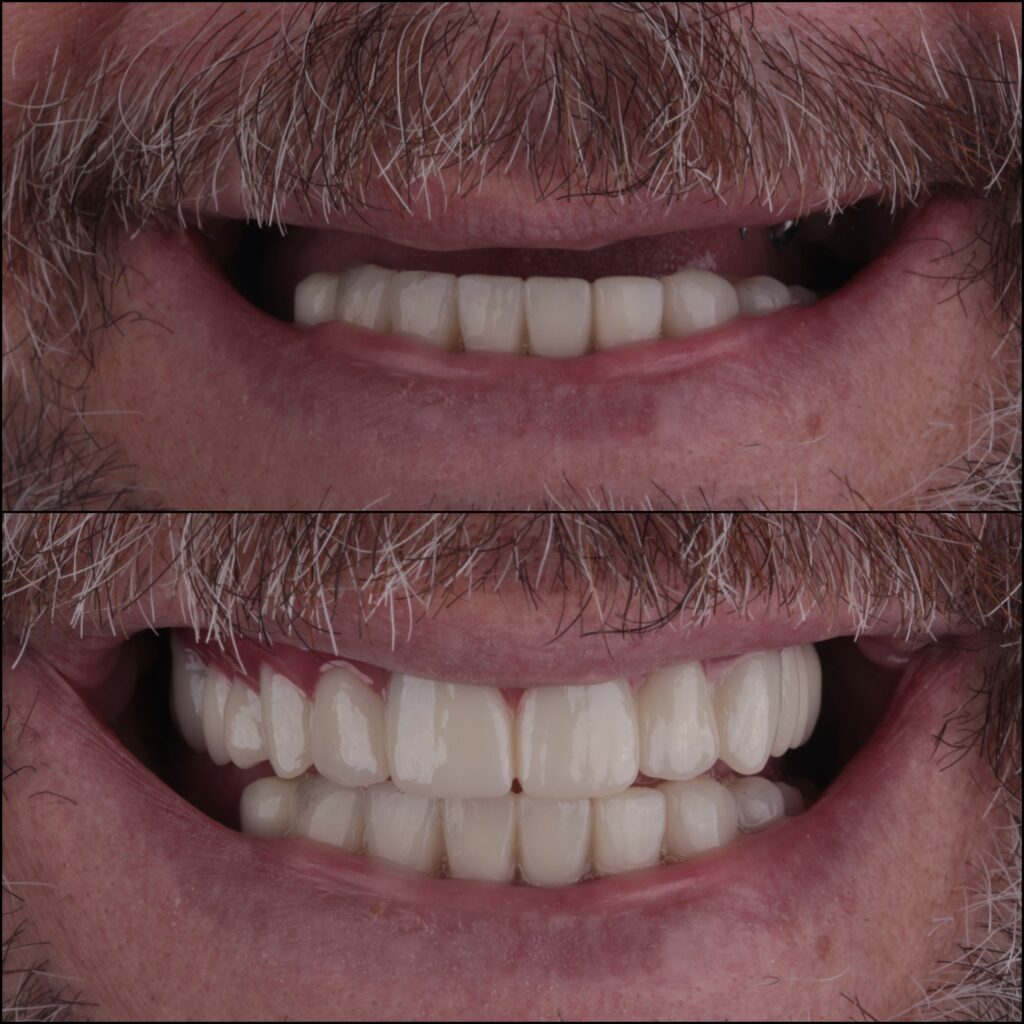
One of the most searched topics when it comes to this procedure is all on four dental implants before and after results. The transformation that patients experience is truly remarkable. Before the procedure, patients typically present with multiple missing teeth, visible bone loss, sunken facial features, and difficulty eating or speaking comfortably. Removable dentures that slip or cause discomfort are a common reality for many of these patients.
After the All-on-4 dental implants procedure, patients leave with a fixed, natural-looking full arch of teeth that are permanently anchored in place. The prosthesis is designed to complement the patient’s facial features and provide a youthful, natural smile. Functionally, patients can eat, speak, and smile with full confidence, without the worry of slipping dentures or adhesive creams.
At Perfect Smile Center, our all on four dental implants before and after cases consistently show life-changing transformations, supported by our digital smile design technology and expert specialist team. We encourage prospective patients to review our real patient cases during their consultation to set realistic expectations and visualize their own potential results.
If what you’re experiencing sounds familiar, early diagnosis can save you time, discomfort, and more complex procedures.
- Accurate diagnosis by dental specialists
- Advanced technology and modern equipment
- Personalized treatment plans
لو الأعراض اللي بتقرأ عنها حاسس إنها شبه اللي بتمر بيه، التشخيص المبكر بيوفر عليك وقت، تعب، وإجراءات أكبر ممكن تحتاجها بعد كده.
- تشخيص دقيق على يد أطباء متخصصين
- أحدث الأجهزة والتقنيات
- خطة علاج مناسبة لكل حالة
The Difference Between Traditional And All-on-4 Dental Implants
Understanding the core differences between these two approaches is essential for making an informed decision about your dental care.
Number of Implants:
Traditional dental implants place one implant per missing tooth, meaning patients with multiple missing teeth may require six or more implants per arch. All on 4 implant technique, by contrast, uses only four implants per arch regardless of how many teeth are being replaced, making it a more streamlined and efficient solution for full-arch cases.
Treatment Time:
Traditional dental implants require a healing period of three to six months between implant placement and final crown attachment. The All-on-4 procedure allows for immediate placement of a temporary prosthesis on the same day as surgery, significantly reducing overall treatment time.
Bone Grafting Requirements:
Traditional dental implants require sufficient jawbone density for successful placement. Patients with bone loss may need a bone graft before implant placement, adding time and cost to the treatment. All-on-4 implants are specifically designed to work with reduced bone volume, and in most cases, eliminate the need for bone grafting due to the angled placement of the posterior implants.
Ideal Candidates:
Traditional dental implants are best for patients missing one or a few individual teeth with adequate jawbone density. All-on-4 implants are ideal for patients missing most or all teeth in one or both arches, or those seeking an efficient and immediate alternative to removable dentures.
Cost:
Traditional dental implants for multiple teeth can be more expensive due to the higher number of implants required and the potential need for bone grafting. All-on-4 implants tend to offer a more cost-effective full-arch solution since fewer implants are used and bone augmentation is rarely needed.
Maintenance:
Both options require regular oral hygiene and routine dental check-ups. Traditional implants can be cleaned individually, like natural teeth. All-on-4 restorations require special cleaning techniques around the supporting implants and prosthesis, which our team will guide you through in detail.
Which Option Is Right for You?
Choosing between traditional and all-on-4 dental implants depends on several individual factors, including the number of missing teeth, available jawbone density, overall health, budget, and personal preferences regarding treatment timeline. There is no one-size-fits-all answer, and the best decision is always made through a thorough consultation and 3D imaging assessment with a qualified implant specialist.
As a general guide, if you are missing one or a few teeth and have good bone density, traditional dental implants are likely your best option. If you are missing most or all of your teeth and are looking for a fixed, immediate, and cost-effective full-arch solution, All-on-4 implants may be the ideal choice.
Whether you need a routine checkup or a specialized dental procedure, you can visit the nearest clinic in one of our prime locations.
- Experienced dental specialists
- Multiple clinic locations
- Flexible appointment scheduling
سواء كنت محتاج كشف دوري أو إجراء علاجي متخصص، تقدر تحجز وتزورنا في أقرب عيادة لك وفي الموعد الي يناسبك.
- أطباء أسنان بخبرة عالية
- أكثر من فرع لسهولة الوصول
- مواعيد مرنة تناسب يومك
Why Choose Perfect Smile Center for Dental Implants in Egypt?
Perfect Smile Center, with branches in Heliopolis and the 5th Settlement (New Cairo), is one of Egypt’s most trusted destinations for both traditional dental implants and All-on-4 implants. Our center uses premium German implant systems, 3D X-ray imaging for precise planning, and the latest digital technologies to ensure predictable, natural-looking, and long-lasting results.
We welcome patients from Egypt and internationally, from the UK, USA, Europe, Gulf countries, and beyond, who choose Egypt for world-class dental implant treatment at a fraction of the cost compared to Western countries, with absolutely no compromise on quality or safety.
Book your consultation today at Perfect Smile Egypt and take the first step toward restoring your smile with confidence.
Frequently Asked Questions About Traditional Dental Implants and All-on-4
Are traditional dental implants painful?
The procedure is usually done under local anesthesia, so patients should not feel pain during placement. Mild discomfort after surgery is normal and can be managed with the dentist’s instructions.
How long does the traditional dental implant process take?
The process may take several months because the implant needs time to heal and fuse with the jawbone before the final crown is placed.
What is the difference between traditional dental implants and All-on-4 implants?
Traditional implants replace individual missing teeth or support bridges, while All-on-4 replaces a full arch using four implants.
Can All-on-4 replace all teeth?
Yes, All-on-4 can replace a full upper or lower arch of teeth using a fixed prosthesis supported by four implants.
Are all on four teeth implants removable?
In most cases, All-on-4 teeth are fixed and can only be removed by the dentist.