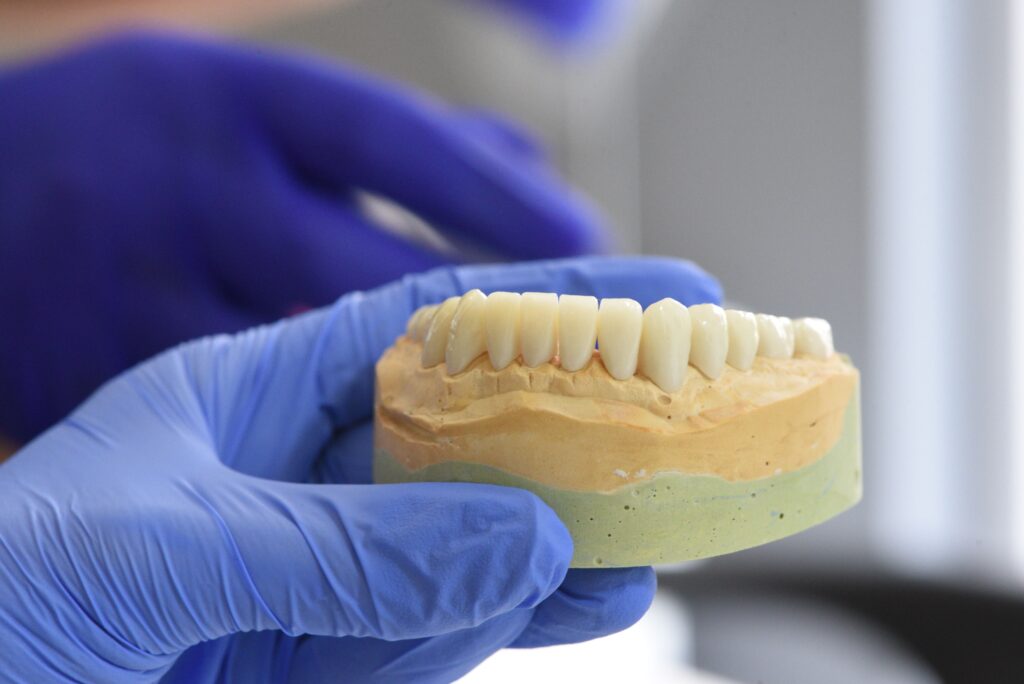
An E-Max Dental Crown is an all-ceramic restoration often chosen when both strength and a natural appearance matter. Made from lithium disilicate glass-ceramic, E-Max crowns can reproduce the translucency and color of natural teeth while restoring teeth that are damaged, weakened, or require full coverage.
However, E-Max is not automatically the best crown for every tooth. Zirconia may be preferred when higher biting forces are expected, while veneers may be more appropriate when the main concern is cosmetics and the tooth does not require full coverage. The right restoration depends on the tooth’s condition, location, bite, remaining structure, and aesthetic requirements.
What Is an E-Max Dental Crown?
An E-Max Dental Crown is a ceramic crown made from lithium disilicate glass-ceramic. It covers the prepared tooth to restore its shape, strength, function, and appearance.
IPS e.max CAD, one commonly used E-Max system, can be designed and milled through CAD/CAM technology. The manufacturer lists crowns, veneers, inlays, onlays, and certain other restorations among its clinical applications.
Dental crowns may be recommended when a tooth is significantly weakened, broken, heavily restored, discolored, or has undergone root canal treatment. Unlike a veneer, a crown covers the tooth more extensively rather than only covering its front surface.
Is E-Max a Porcelain Crown?
E-Max is often described as a type of porcelain or all-ceramic crown, but more specifically, it is made from lithium disilicate glass-ceramic.
This distinction is important because not all ceramic crowns use the same material. E-Max has its own optical and mechanical characteristics, while zirconia crowns are made from zirconium dioxide and have different strength and translucency properties.
What Are the Advantages of E-Max Crown Teeth?
One of the main advantages of E-Max crown teeth is their ability to closely reproduce the appearance of natural enamel. The material is available in different levels of translucency and shades, allowing the restoration to be selected according to the surrounding teeth and clinical situation.
Other potential advantages include:
- Natural appearance: The translucency of lithium disilicate can help create a lifelike result, particularly in visible areas.
- Good clinical performance: A 2025 overview covering around 35,000 lithium-disilicate crowns reported short- and medium-term survival rates of approximately 95% to 100%, although the authors noted limitations in longer-term evidence.
- Metal-free restoration: E-Max contains no metal framework.
- Use in front and back teeth: Lithium-disilicate crowns can be used in both anterior and posterior areas when clinically appropriate.
- CAD/CAM compatibility: E-Max CAD restorations can be digitally designed and milled using compatible systems such as CEREC.
At Perfect Smile Dental Center, CEREC technology is used for same-day crown workflows, including digital scanning and in-office crown fabrication where the treatment is suitable for this approach.
What Are the Disadvantages of E-Max Crowns?
Despite their advantages, E-Max crowns are not suitable for every clinical situation.
Because E-Max is a ceramic material, fracture remains possible, particularly when the restoration is exposed to excessive forces. The condition of the tooth, crown design, material thickness, bite, and habits such as grinding or clenching can all influence treatment planning.
Other considerations include:
- Some natural tooth structure must usually be removed to create space for a crown.
- Temporary tooth sensitivity may occur after crown preparation or placement.
- Ceramic restorations can chip or fracture.
- A poorly fitting or damaged crown can allow plaque accumulation and increase the risk of problems around the tooth.
- Patients who grind or clench their teeth may require additional protection, such as a night guard.
The decision should therefore be based on a dental examination rather than choosing a crown material based only on appearance.
E-Max vs Zirconia Crown: Which Is Better?
There is no single answer to whether an E-Max crown or zirconia crown is better. Each material has characteristics that can make it more appropriate for particular teeth and treatment goals.
| Factor | E-Max | Zirconia |
| Material | Lithium disilicate glass-ceramic | Zirconium dioxide ceramic |
| Aesthetics | High translucency and natural appearance | Good aesthetics; translucency varies by zirconia type |
| Strength | Strong for many single-crown applications | Generally suited to higher biting forces |
| Common use | Often selected when aesthetics are a major priority | Often selected where additional strength is important |
| Front teeth | Frequently suitable | Also suitable |
| Back teeth | Can be suitable depending on the case | Frequently used |
Clinical evidence does not show that one material universally outperforms the other. A systematic review involving 2,436 zirconia and lithium-disilicate crowns found broadly comparable survival and complication patterns within the limitations of the available studies.
Which Is Stronger, Zirconia or E-Max?
In general, zirconia has greater mechanical strength and can tolerate heavier forces than many other ceramic materials. Cleveland Clinic describes zirconia crowns as highly durable and able to withstand heavier biting forces.
E-Max is still a strong restorative material. Ivoclar reports a biaxial flexural strength of 530 MPa for IPS e.max CAD after crystallization.
Strength alone, however, should not determine crown selection. Tooth position, bite forces, available tooth structure, aesthetics, and the restoration design all matter.
Which Looks More Natural: E-Max or Zirconia?
E-Max is often considered when a highly natural, translucent result is needed because lithium disilicate can reproduce optical characteristics similar to natural enamel.
IPS e.max CAD is available in multiple translucency levels and shades specifically designed to help restorations blend with surrounding teeth.
Modern zirconia can also provide very good aesthetic results, particularly newer translucent formulations. Therefore, the most natural-looking result depends not only on the material but also on shade selection, underlying tooth color, crown thickness, laboratory or CAD/CAM design, and the dentist’s treatment plan.
When Is an E-Max Crown a Good Choice?
An E-Max Dental Crown may be considered when a tooth needs full coverage, and aesthetics are an important part of treatment.
Possible indications may include:
- A damaged or weakened tooth
- A tooth with a large restoration and limited remaining structure
- Certain teeth following root canal treatment
- Discolored or misshapen teeth requiring full coverage
- Front teeth where natural translucency is particularly important
- Selected premolars and molars when the bite and clinical conditions are appropriate
Crowns are commonly used to protect weak or broken teeth, restore worn teeth, and cover some root-canal-treated teeth.
The dentist must first assess whether a crown is actually necessary. In cases where the tooth is healthy and the concern is mainly dental cosmetic, a veneer or another more conservative option may sometimes be considered.
How Long Do E-Max Crowns Last?
There is no fixed lifespan that applies to every E-Max crown.
A large 2025 review found high short- and medium-term survival of lithium-disilicate single crowns, with rates generally between 95% and 100%. However, the authors also highlighted limited high-quality evidence beyond five years and advised against assuming that every restoration will have the same long-term outcome.
Earlier research also reported a 5-year cumulative survival rate of 97.8% for lithium-disilicate single crowns, although longer-term evidence was more limited.
How long an individual crown lasts can be affected by:
- Oral hygiene
- Biting and chewing forces
- Teeth grinding or clenching
- Tooth condition beneath the crown
- Crown fit
- Regular dental examinations
- Trauma or biting very hard objects
For dental crowns more generally, Cleveland Clinic gives an average lifespan of approximately five to 15 years, although some crowns can last longer with good care.
How Is an E-Max Dental Crown Placed?
The process begins with an examination of the tooth and surrounding tissues. The dentist determines whether the tooth can support a crown and whether E-Max is an appropriate material.
The tooth is then prepared by removing enough enamel to create space for the restoration. A digital scan or impression is taken to record the prepared tooth and surrounding teeth.
With a CAD/CAM workflow, the crown can be digitally designed and milled from an E-Max ceramic block. IPS e.max CAD is compatible with systems including CEREC and inLab equipment. After milling, the restoration undergoes the required crystallization and finishing process to develop its final strength, shade, and translucency.
The dentist then checks the crown’s:
- Fit
- Bite
- Shape
- Contact with neighboring teeth
- Shade and appearance
Once satisfactory, the crown is bonded or cemented into position.
Perfect Smile uses digital scanning and CEREC technology for same-day crowns in suitable cases, which can allow crown preparation, digital design, fabrication, and placement to take place within one visit.
How Do You Care for E-Max Crown Teeth?
An E-Max crown does not require a completely different hygiene routine from a natural tooth, but the tooth underneath it and the surrounding gums still need consistent care.
To help protect the restoration:
- Brush twice daily with fluoride toothpaste.
- Clean between your teeth every day.
- Attend regular dental examinations and professional cleanings.
- Avoid regularly biting ice or extremely hard foods.
- Do not use your teeth to open packaging or bite non-food objects.
- Tell your dentist if you grind or clench your teeth.
People with bruxism may be advised to use a custom night guard to reduce excessive forces on crowns and natural teeth.
Contact Perfect Smile Dental Center, if the crown becomes loose, develops a chip or crack, causes persistent pain, or your bite suddenly feels different.
At Perfect Smile Dental Center, crown treatment is planned according to the condition of the tooth, bite, aesthetic requirements, and individual needs. The center provides crown and bridge treatment at its Heliopolis and 5th Settlement branches and uses digital technologies including CEREC and inLab MC X5 for crown fabrication.
Frequently Asked Questions About E-Max Crowns
Which Crown Is Better for Front Teeth, Zirconia or E-Max?
Both can be used for front teeth. E-Max is often considered when translucency and highly natural aesthetics are priorities, while zirconia may be considered when additional mechanical strength or masking of the underlying tooth is important.
The final choice should be based on the tooth’s condition, color, bite, remaining structure, and aesthetic requirements rather than material name alone.
Can E-Max Crowns Be Used for Back Teeth?
Yes. Lithium-disilicate E-Max crowns can be used on selected posterior teeth. IPS e.max CAD includes blocks intended for single crowns in anterior and posterior regions.
However, posterior teeth experience greater chewing forces. Patients with heavy bites, limited restoration space, or significant grinding may require a different material or additional protective measures.
What Is the Difference Between E-Max Crowns and E-Max Veneers?
When comparing E-Max crowns vs veneers, the main difference is how much of the tooth they cover and why they are being used.
An E-Max crown covers most or all of the prepared tooth and is commonly used when the tooth requires structural restoration or protection.
A veneer is a thin restoration bonded primarily to the front surface of the tooth and is generally used to improve cosmetic concerns such as discoloration, shape, small chips, or gaps. The American Dental Association notes that veneers cover the front surface rather than the entire tooth structure.
A veneer is therefore not simply a thinner version of a crown. The condition of the tooth determines which restoration is appropriate.
How Long Will an E-Max Crown Last?
Many E-Max crowns can remain functional for years when they are appropriately selected, correctly placed, and properly maintained. Studies show strong short- and medium-term survival for lithium-disilicate single crowns, but there is no guaranteed lifespan for an individual restoration.
Regular dental care, good oral hygiene, bite forces, and habits such as grinding all influence how long a crown may last.
Sources and References
- Cleveland Clinic
Dental Crowns: Types, Procedure & Care
https://my.clevelandclinic.org/health/treatments/10923-dental-crowns
- American Dental Association (ADA) – MouthHealthy
Veneers
https://www.mouthhealthy.org/all-topics-a-z/veneers
- Journal of Prosthetic Dentistry – PubMed
Effect of Cement Type on the Clinical Performance and Complications of Zirconia and Lithium Disilicate Tooth-Supported Crowns: A Systematic Review
https://pubmed.ncbi.nlm.nih.gov/30885580/